Monday, November 11, 2013

The Fairytale Village (Day 9, Tuesday, October 29, 2013)

Theresa and I are happy to be in an efficient touring tourist pattern: lay out our clothes the night before, wake up with the alarm clock, get ready, go the the rooftop hotel dining room in Rome for a fairly leisurely and sumptuous breakfast, then either climb on the bus or gather with our group to walk.

Since the Vatican is very close, today we all walk to the Museum.  It is cool and we don't mind the long walk around the tall, old brick walls to reach the entrance.  Since we're with  guides, we are thankfully able to bypass the very long line as we are handed our tickets.  Our destination: the Sistine Chapel.

Tall walls around Vatican City.

Woo-hoo!  We've made it to the entrance!
"Sphere Within a Sphere," a sculpture in motion, in the Courtyard of the Pinecone in the Vatican Museum
Our group spent quite some time with our tour guides in this Courtyard.  Using the posters set up on one side, the Guides explained the details of Michaelangelo's paintings both on the ceiling and the 'altar wall.'  This was immensely helpful!  We then passed through galleries of antiquity and the "Map Room."

Magnificent, ornate ceiling in the "Map Room."  A person would probably have to spend a month in each room to fully take in the beauty and significance of each painting and sculpture.  We were allowed to take photos everywhere except the Sistine Chapel, whose 500-year-old frescoes are extremely fragile.
One of the maps in the Gallery.  This is a long hall leading to the Sistine Chapel.  The maps are 430 years old, depicting various sections of Italy at the time and seem remarkably accurate, given the skills of the mapmakers at that time.

Doorway between halls.
Every detail is unique.  What wonderful craftsmanship!
In the Sistine Chapel, we stood in awe of the paintings of "Creation" on the ceiling, and the "Last Judgment" on the Altar Wall.  The crowd was instructed to keep silence as this is a holy place.  The prior information from our guides was immensely helpful.  Michaelangelo considered himself an architect and sculptor par excellence (the best!).  The Pope of the time, Pope Julius, wanted his chapel decorated by The Best.  Michaelangelo protested that he was not a painter.  The Pope told him that he was The Best and he could figure it out!  Then Michaelangelo learned how to paint frescoes, a tricky process involving applying pigment onto wet plaster, before it dries.

There are nine separate paintings that tell the story of creation on the ceiling. The first three tell the story of Noah, the Ark, and the Great Flood.  These were painted first.  Michaelangelo designed the scaffolding that enabled him to paint on the 60-foot tall ceiling.  After painting these first three scenes, the artist was not pleased because the figures were too small to be adequately seen from the floor. The next figures were much larger with fewer details in the paintings.

The next three paintings of Creation show the creation of Adam, Eve, and their expulsion from the Garden of Eden.  God created them young and beautiful.  After they sinned, they are older and unhappy.  The last three scenes show God separating the water from the land, the planets, and separating the light from darkness.  What genius!  The ceiling was painted from 1508 to 1512.

I personally spent more time transfixed on the Last Judgment painting on the Altar Wall.  It is sobering to see Jesus sending those going to heaven in the upper part, full of light and happiness, and those damned to hell in the lower part, full of darkness and misery.  I feel that what will happen on Judgment Day will not surprise any of us: we have made daily choices during the whole of our lives, for good or evil.  We will earn the eternal bliss of heaven or condemn ourselves to the eternal misery of hell, after our deaths.

Since the figure of St. Bartholomew was pointed out to us, close to Christ on the Last Judgment painting, I realized I had not even noticed it the other time I visited the Sistine Chapel.  The saint was skinned alive!  In this painting, he is an ordinary man holding his sagging skin!  Amazingly enough, there is a statue of St. Bartholomew in St. Peter's Basilica.  He is also holding his sagging skin.  (I have found that the rich, 2000-year history of the Catholic Church is never boring!!)

On the side walls are large paintings of the Life of Jesus and also scenes of Old Testament chronicles.  They are very meaningful.  I will have to focus on them more the next time I visit the Sistine Chapel!


Our time in the Sistine Chapel is up and we exit to a courtyard.  We have a break to visit the restrooms and/or shop.
At last, we visit St. Peter's Basilica!
Shortly after entering St. Peter's, on the right side, is Michaelangelo's statue of the Pieta, or sorrowful Virgin Mary, Mother of Jesus, holding him after he was lowered from the cross, dead.  Mary is larger in proportion than she would be in real life, or else Jesus is smaller.  Michaelangelo sculpted this when he was only twenty-five years old;  it is the only work he ever signed because others thought he was too young to have accomplished such a great work.
Obelisk in the center of St. Peter's square.

Main altar in St. Peter's.  The bronze candle holders are on the semi-circular fence around stairs leading to the first lower level below the altar; the remains of St. Peter are there.
Angels hold huge Holy Water Fonts in which the faithful dip their fingers and bless themselves upon entering the church.  Every Christian should make a Pilgrimage to St. Peter's Church a priority at least once in their lifetime!  I cannot convey to you the immense size and spirituality of this heavenly place! You must see it for yourself!
   Dozens of tall statues of Apostles and Saints have stood for centuries on the top of the church and on the top of the semi-circular colonade in the plaza.


The Baldachino, or canopy over the main altar, constructed out of bronze by Bernini, approximately ninety feet tall and weighing 93 tons!  Note the bright circle at the lower left: it is the Holy Spirit stained glass window.


The large and magnificent Holy Spirit window, in the extreme front of the church, directly over St. Peter's Chair (symbolic)
I'm standing in front of my favorite statue in the entire church, Pope Alexander VII, with his hands folded in prayer.  Directly in front of him is the golden skeleton of Death, holding up a golden hourglass, to inform him that his time on earth is nearly finished.

Detail of the statue: Death seems to emerge from the marble rock.  It is said that the skeleton was extremely difficult to place.


The dome over the main altar is over 200 feet high!  It was designed by Michaelangelo.  A few of our group opted to walk up to the dome (over 300 steps).  I declined but plan on doing this the next time I'm there!


The front of St. Peter's.  Note the statues on the top in the front with the large dome peeping over the top.  The plaza is set up for the Papal Audience tomorrow.


T
The right colonade, very wide on the plaza in front of St. Peter's church.


 Statue of St. Helen, mother of Emperor Constantine who made Christianity the official religion of the Roman Empire.  St. Helen went to the Holy Land and found the true cross of Jesus Christ.  She built many churches in the Holy Land.

There is time to shop and grab lunch in Rome.  Then we all board the bus for a ride in the countryside to the place of the Pope's official summer residence, the village of Castel Gandolfo.  This very small village is on the shore of a picturesque lake, Albana.


The Pope's summer home in Castel Gondolfo.

It is near dusk and we have a little time for shopping in the small shops before Mass.  There is a fountain in the cobblestone square.  See the narrow street behind the fountain.


Father Richard celebrates Mass for us in St. Thomas parish church in Castel Gandolfo.  The church is another work of art by famous artist, Bernini.

Main altar, St. Thomas church, a treasure smaller but equal to those in Rome.

Before dinner, we descend into a cave of a shop basement for a delightful Wine Tasting.  We sample both the sweetest and the thickest wine we've ever had.  It was so fun!

After another memorable Italian dinner, we walk around down around the narrow cobblestone streets and ultimately hook up with our bus.  Home again, to our hotel in Rome.  Every day here seems to be better than the last.  I MUST return to this Village of My Dreams. . .


Sunday, November 10, 2013

Underground Today (Day 8, Monday, October 28, 2013)

There is an unseen City of the Dead under Rome: the Catacombs, Christian burial places.  Of the 60 different catacombs, only 4 are open to the public.  Today we journey to St. Callixtus' Catacombs, outside the Old City walls of Rome.  An astounding 500,000 people were buried in all the catacombs!  Most were Christians, some were Romans, not all were martyrs.
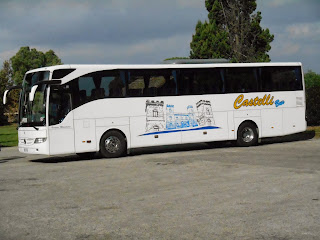
Our comfy tour bus for Italy.  Since 22 more have joined our tour, we now fill up the bus with 52 (plus one or two or three guides!).  This group includes 5 priests and 2 deacons with tourists from all corners of America and several from Canada.

We must past through the walls of the Old City first.


Since photographs were prohibited in the catacombs, I will attempt to describe them for you.  Before we began the tour, our guide told us, "Be very careful to stay with the group.  We don't want you to get lost.  It takes three years for the catacombs to be checked.  It might take a while to find you."  (No problem, ma'am; we'll stay very close to each other and you!)

While there were handrails to help with ascending or descending the stairs. they seemed to be the original stone stairs, rough hewn.  It was quite a change going from outside in the sunlight to going down the first dark, steep stairways.  Passageways are very narrow, lit by single electric light bulbs, at intervals.  It is cool but not quite cold in all places.  There are five levels of the catacombs.  We go down two or three levels but it is hard to keep track of that because we walk up and down and turn corners frequently.  Some of the 'rooms' are large, with layers of empty tombs stacked up five levels.  The tombs were cut out individually, according to the size of the person's body, and placed randomly in the walls.  Some are lavishly decorated.  Many have Christian symbols carved out.  It is sad to see the many tiny graves, but the death rate for babies was high in Roman times.  Some tombs seem wider and were built for more than one person.

The catacombs were not used as places in which to hide.  We saw no bones!  The graves were plundered in past centuries.  There is one statue of a young woman lying on her side.  It depicts St. Cecilia.  Her crypt was found in the year 1598; after it was opened, her body was found 'incorrupt' (not decayed, not embalmed).  One of St. Cecilia's hands is pointing with one finger.  The other shows three fingers.  This is the symbol of the Trinity, God, three persons in one, Father, Son, and Holy Spirit.  St. Cecilia was beheaded.

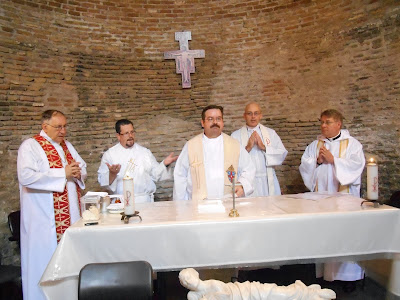
Our Mass today is in this small chapel above ground near the entrance to the catacombs.


Our priests and deacon (second from left) celebrating Mass. (Father Gilbert sat this one out, due to the small space.)
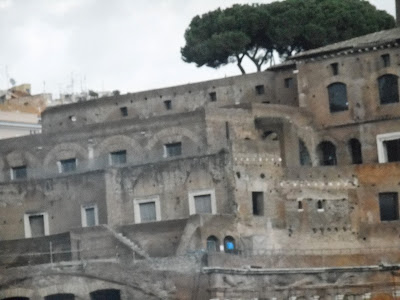
We drove around the old city and saw many of the Roman ruins.  
Rome at the time of Christ was a bustling city of more than 1,000,000 citizens.  The Romans constructed immensely large and grand public buildings.  The public baths were two stories high and featured hot water.  Circus Maximus was an arena which held 150,000 spectators.  The Appian Way was a cobble-stoned highway stretching from Rome to the far reaches of the Empire.  A legend says that during the time of the greatest persecutions, St. Peter, the first leader of the new Christian church, was walking the Appian Way away from Rome.  He met Jesus who was heading back into Rome.  Peter said, "Quo vadis, Domine?"  (Where are you going, Lord?) Jesus told him, "I'm going back to Rome to get crucified again."  Peter got the message, turned around and walked back to Rome where he eventually was crucified - upside down.  He  said he was not worthy to be crucified in the same way as his Lord.
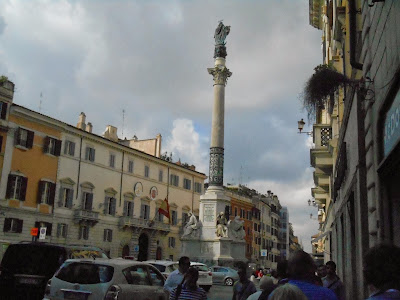
Roman architecture is lovely everywhere.  There are many piazzas, or plazas.  Most have a graceful, working fountain.  There are also columns in many locations, some in the middle of a fountain, most topped by a religious statue.

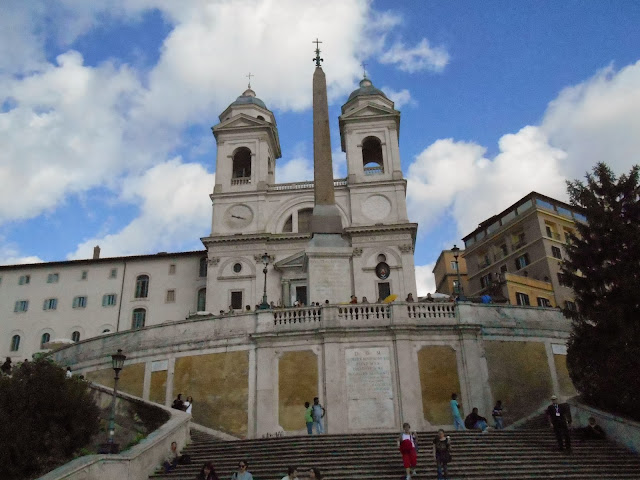
The fabulous, renowned Spanish steps.  The lower levels were full of sitting tourists and locals.  But there were small spaces for climbing.  At the top is Trinity Church.
Ten years ago, Cathy and I climbed these same Spanish steps in 95 degree heat!  Today the weather is mid-70's, significantly more pleasant.  Ten years ago, the building at the top of the stairs was encased in plastic, undergoing renovation.  I had no idea what is was. Restaurant?  Store?  It is Trinity Church, another one of the unique, grand churches in Rome.
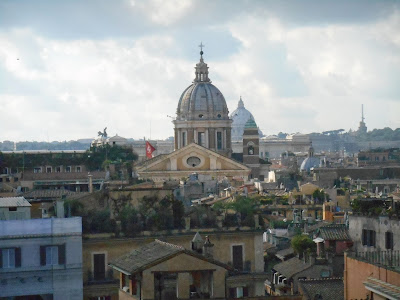
View of Rome and St. Peter's Dome from the entrance of Trinity Church.  There is a law that in the Old City no building may be tall enough to compete with St. Peter's Basilica.

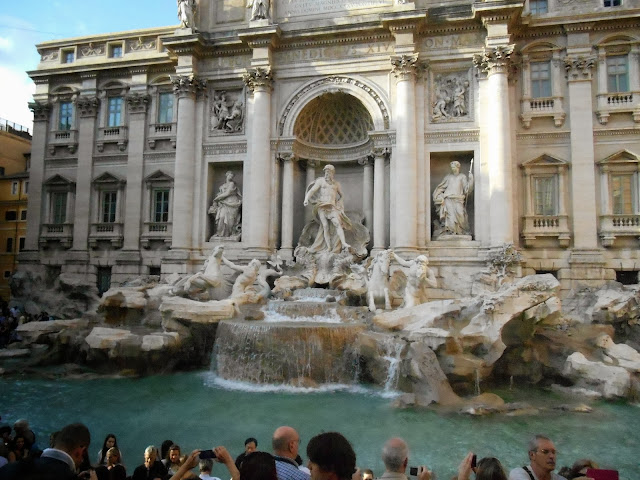
The Trevi Fountain, one of my very favorite places in Rome.  Ten years ago, when I first saw this, illuminated at night, I prayed, "God, thank you for letting me see this. But I wish you would have let me seen this on the last day of my life.  Nothing will ever be more beautiful!"  There is so much water flowing, it is LOUD at times!  The fountain is actually the back of the City Water Works.  One of the old Roman Aqueducts was built solely to bring water to the Trevi Fountain!
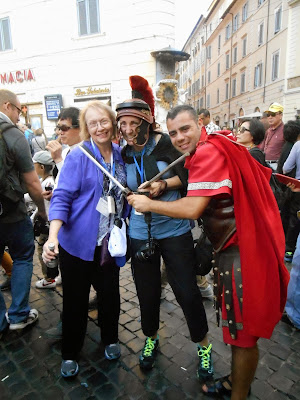
Guarding the Trevi Fountain are 'real' Roman Soldiers, very willing to have their photos taken with us (for a slight fee).


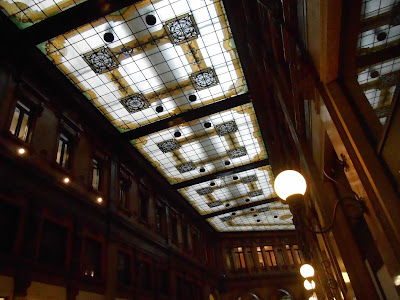
We pass through a shopping/office mall with a center for Robert Kennedy Studies on our way to our next site.  (Ceiling detail)


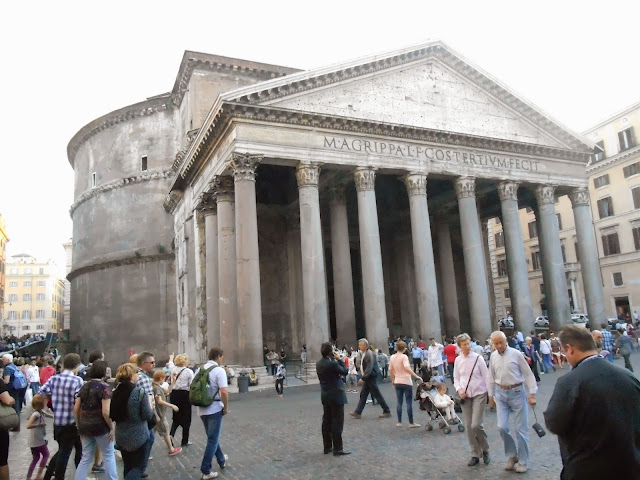
The Pantheon, major Roman Temple for gods, changed to a Catholic Church when the Christian religion was officially approved.  It was built in 27 B.C.
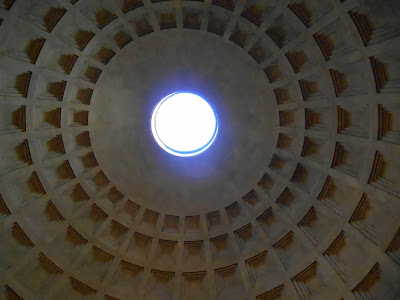
The dome of the Pantheon is 142 feet tall, open to the air, an architectural wonder, and still the largest dome in the world built with unreinforced concrete!  Our guide told us that Michaelangelo studied this dome to get an idea of how to build the large dome in St. Peter's basilica.
All parts inside and outside of the Pantheon, are interesting.  A section has been left as it looked in pre-Christian times, with walls of bricks, not marble.  There are altars; at one a Mass is in progress.  Two kings are buried there in large black crypts.
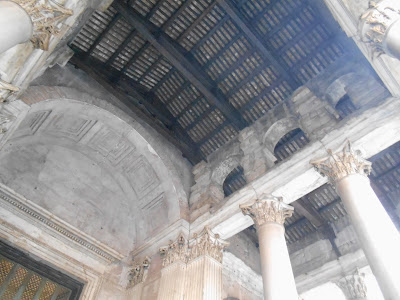
The Pantheon's Portico's ceiling is wooden, one of the few wooden ceilings I've seen outside in either Rome or Israel.

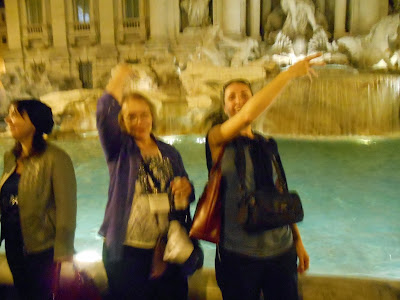
Since I've told everyone how magnificent the Trevi Fountain is when lit up at night, 15 of our party opt to go out after dinner to see it.  The water from the fountains splashes even more loudly with fewer tourists present.
Jan and Theresa, following tradition, tossing coins over our left shoulders into the Trevi Fountain.  This means we'll come back to Rome some day!!
As the greater part of our group returned to the hotel after dinner (another memorable Italian banquet!), the rest of us are left to catch cabs.  Fortunately for us, our priests have been to Rome multiple times and know how to haggle!  After rejecting several 'crooks trying to take advantage of us,' Father Gilbert finds 'honest' cabbies, 3 of them, who will charge us only 15 euros (each cab) for the trip back to the hotel.  Frankly, it was a wild ride and I found myself praying that our cabbie wouldn't run over anyone, several times!  Another adventurous day in our trip. . .

Saturday, November 9, 2013

Good-bye Israel, Hello ROME! (Day 7, Sunday, October 27, 2013

Groan, we get up at 3 a.m., are all on the bus at 4 a.m., for a 3-hour trip to the airport at Tel Aviv. (Please note: we always took breaks on these long trips!) The whole group of us are sad to say 'good-bye' to our most wonderful guide and new friend, Rami.  We check in and go through customs and are on our way in the air.  The only delay was waiting one hour to make sure it was clear to fly over Syria.

Rami and Theresa say 'farewell' at the Tel Aviv airport.
We are flying Alitalia air line today, an uneventful flight of 3 hours, 50 minutes duration, 1,404 miles.  Getting through the Rome airport, however, was a drudge as many of the workers were on strike.  With only one or two Customs agents for several planeloads, the line challenged all our collective patience.  We met our new tour guide and reached our new hotel, Hotel dei Consoli Vaticano.  Ready to eat dinner and rest, we found we had a new option: go see the Church of Mary Major.  I went, happily.

Ten years ago, I had the wonderful experience of touring Rome, Florence, and Venice, with daughter #3, Cathy.  I was semi-worried I'd see all the same things but terribly wanted to go to Israel and came to Rome again.  With 400 Catholic churches in Rome, I should not have been concerned!  As it turned out, the only sites I visited for the second time in Rome were St. Peter's church and square, the Vatican Museum, the Coleseum, and the Trevi Fountain.

Mary Major Basilica Church was new to me.  And it was well worth the effort!  The church is huge, magnificent, rich in history, almost glowing in the evening light.


St. Mary Major Church, Rome, Italy.


The main altar at St. Mary Major.  Imagine churches in which every surface, floor to ceiling and walls, is decorated richly.  Every church we visited in Rome looked like that!  The whole of the Old City is a museum of antiquity, well-loved and well-maintained by the Romans.  You cannot imagine the many different colors of marble until you've been in the Roman churches.
Unsurpassed beauty!

It was good to leisurely travel through the city on the big tour bus.  Previously, Cathy and I walked or took city buses everywhere.  This was much safer!  I think many folks would agree that the traffic in Rome is among the worst in the world!  It is somewhat better than ten years ago when there were seemingly millions of mopeds insanely going where they pleased (even on the sidewalks, at times), and when they pleased.  Now there is a majority of 'smart' cars, cars so small they can park 'sideways' in the parking places.  Finally, we reached our hotel, small but quite elegant.  We particularly enjoyed the rooftop garden bar/dining room.  From there we had a good view of the city and could see the dome of St. Peter's.

 Rooftop garden dining room at Hotel dei Consoli Vaticano


 Special friends from Lexington, Margaret with brother, Archie.  This is at an Italian restaurant across the street from the hotel.  The food and wine was so wonderful we were all quite stuffed!

It would be impossible to determine who fell asleep first, Theresa or me.  We were tired, thrilled to be in Rome, and pleased with our new room, our new friends, and Life!


Friday, November 8, 2013

Diamonds and Marriages (Israel, Day 6, Saturday, October 26, 2013)

The Sabbath is today in Tiberias, as well as in all Israel, and all the stores are shut down to observe this.  There is virtually no traffic as we leave in our big tour bus.  The rising sun over the Sea of Galilee is stunning.  We notice the bare hills of the Golan Heights on the other side of the Sea.  The city is really beautiful with trees and flowers everywhere.

The last sunrise we'll observe from the Rimonim Hotel in Tiberias.

The Franciscan Church of the Miracle at Cana is the site of Jesus' first miracle, when he turned water into wine at the request of his mother, Mary.
The Catholic Church at Cana.
We descend into the crypt, one level below the main church, to view the historical exhibits.  This is a wine jug similar to the ones in use in Jesus' time.
This painting in the Cana Church depicts the wedding where Jesus changed water into wine.
Our daily Mass, today at the Cana Church, was very special. Seven couples from our group, including Father Jeff's parents,  renewed their wedding vows.  From left are Father Richard, the celebrant, Father Jeff, and Father Gilbert.

Basilica of the Church of the Annunciation, Nazareth.
Painting showing the Angel of God announcing to the Virgin Mary that she is to be the Mother of God.

This is the first lower level of the Annunciation Church.  The church is lovely and architecturally interesting.  There is a large opening in the floor of the first level, visible at the top of this photo.

Nearby is the Church of the Holy Family.  This sculpture is outside, in a niche.

Our group next journeyed to Capharnaum to the house of Peter's mother-in-law.  On the way we noticed a few multi-level houses that appeared to have an incomplete top story.  Rami told us of the Arab custom: when a son is born, the father will add an upper level to the house.  When the son gets married, the father will finish this level.


This is the altar in Peter's mother-in-law's house.  The church looks like a space ship outside!  In the center is a glassed-in area on the floor where the ancient house is visible.  It is easy to imagine, from this vantage point, the crippled man being lowered in a hole through the roof.  Then Jesus forgave his sins and told him to get up and walk, which he did!

Excavated area showing the different rooms of the ancient stone house.

These are the ruins of the Synagogue where Jesus preached!  It was good to walk around, look about the countryside, and imagine Jesus walking on the very stones of the floor.

Our last stop today was a surprise: the Israel Diamond Exchange!  Rami told us that for many years, Israel was the top dealer in diamonds in the world. Now, he says, computer technology has surpassed diamonds in economic importance in the country. First, we saw a short movie telling where diamonds were found in the world, how they were formed, and how they were cut.  Then we browsed a large showroom with incredibly magnificent jewelry (with equally incredible prices!!). I inquired about a small pair of diamond earrings.  The sales clerk brought them out and said the price was 40,000 euros - but - it would be cheaper just to buy the diamonds without a setting! (No thanks!!)

We piled back in the bus after several folks actually did buy jewelry.  After a trip to the hotel, we had a wonderful dinner, as usual, packed, and went to bed early.  Tomorrow we'll go to the Eternal City, ROME!


Thursday, November 7, 2013

Israel Extra: The Camel Girl!

There are many sidewalk vendors in Israel.  They are polite and mostly try to get the tourists to buy 'real cashmere' scarves, made in P.R.C. (Peoples Republic of China) for $5 each, or 5 for $20, or a string of postcards.  At one small town, a young vendor called after Theresa, "Marry me and I'll give you a camel!"

After we came out of the church we were touring, we walked by the same vendor, and he called out even louder to Theresa, "Marry me and I'll give you 500 camels!"  Our group chuckled over this and good-naturedly teased Theresa about this for the rest of the trip.  Later, I surprised her with a camel magnet, to make sure she didn't forget about the camels.  Stephanie and David presented her with a beautiful leather camel, in memory of the occasion.

Rami calculated that 500 camels would probably bring in a million dollars.  I reminded Theresa that in the Bible, the parents were given the dowry when their daughter was married, so I should be given the money.  She really didn't like that suggestion and insisted that she would keep the proceeds.

The Bride and Her Camel
 Alas, somewhere in Israel is a sad, disappointed young Arab gentleman!