Thursday, November 7, 2013

Of Seas and a Desert (Israel: Day 5, Friday, October 25, 2013)

Our first glimpse of Israel's Dead Sea, early in the morning.  It is a salt-water sea.
Qumran National Park, on the shores of the Dead Sea, Israel.
Qumran is the site where a wandering nomad found the most important discovery of the Dead Sea Scrolls, an early Old Testament of the Bible, in the late 1940's.  We are able not only to see the entrance to the cave where, by tossing a rock into the cave, and hearing something break, the nomad found urns with scrolls, we enter the complex where the Essenes lived before Jesus' time.  It is thought that John the Baptist lived here with them at one time.  Since I have read about the Dead Sea Scrolls discovery in the National Geographic Magazine when I was a little girl, and also more recently visited the exhibit in Kansas City, Kansas, U.S.A., I am very excited to actually be at this place.

The Cave where the Scrolls were found, very high on a cliff.
In the museum is a depiction of how the inside of the cave appeared when the Scrolls were found.
Qumran museum is professionally done, with explanations of how well organized was the Essene sect (of the Jewish religion).  The large community of men lived sparsely and prayed often.  The blazing October sun reminded us of how blistering the summer sun must be at over 100 degrees F.

Water, a precious commodity in the desert, was conserved in wells for ritual baths and drinking.  Here has been excavated an irrigation ditch.


Jericho, the oldest city in the world, settled in 8,000 B.C., is one of the first cities we pass through.  Rami points out a sycamore tree, like the tree Zaccheus climbed up into to better see Jesus.  He tells us, "This tree could not have been living at the time of Jesus, it's a young tree, only about 500 years old."  There's some time for shopping in Jericho; I select two blue and white ceramic plates to add to my dining room wall collection.

The 'young' Sycamore Tree


Our bus ride today is most interesting!  There are barbed-wire topped fences everywhere, sometimes two or three lines of fences close to each other.  We see red signs hanging on the Jordan-Israel border, "Danger - Mines," a reminder of a past war with wounds still visible.

This country is hilly, dry, with red soil and nearly no vegetation.  There are a few herds of sheep scattered on hillsides.  We ask Rami what they can possibly eat.  He reports, "They survive on the dried plants."  We marvel at the extensive banana farms, covered with black mesh.  The bananas are covered with blue plastic.  We all joke about the blue bananas.  There are also date palms and citrus orchards. All are fenced. Goats and donkeys keep the weeds down in the date orchards.  We see a line of them scampering inside a fence.

Next: the River Jordan, where Jesus was baptized by John the Baptist. 
The River Jordan is not much more than a wide stream at this point.  It was gratifying to be able to either stand in the river or put our hands in the river, slow-flowing, and muddy.  The reeds on both sides of the river were tall and lush.  Israeli soldiers with machine guns patrolled our side.  Jordanian soldiers with machine guns patrolled the other side.  I wondered, "Who would possibly want to test these guys by trying to cross over?"  It was very meaningful to renew our Baptismal Vows here.

Father Richard leading us in Baptismal Vow Renewal on the banks of the Jordan River, Israel.
Theresa, knee high in the River Jordan.
Lush vegetation on the banks of the river; desert everywhere else!
Our first view of the beautiful Sea of Galilee, a fresh-water inland sea.

We move our luggage to a new hotel, Rimonim Galei Kinnereth Hotel, in the city of Tiberias, on the shores of the Sea of Galilee. Our rooms are large; we feel we are at a resort.  The city of Tiberias has many black stone buildings and fences.  Rami explains that the black rock is volcanic.  We ask, "How long ago did the volcanoes erupt?"  Rami guesses, "Oh, about 40 million years ago!"

After dropping off our luggage, the bus takes us to the Mount of the Beatitudes on the seashore.  To walk where Jesus taught the crowds - it is almost too thrilling to bear, at times!  The retreat center there, and the nuns who are custodians, are very welcoming.  I found myself wishing I could stay there for several weeks. . .


Father Gilbert celebrates Mass for us on the Mount of the Beatitudes, with Father Jeff (left) and Father Richard (right) concelebrating.
View of the Sea of Galilee from the Mount of the Beatitudes.
We then visited the Church of the Multiplication of the Loaves and the Church of the Primacy of Peter.  The undisputed highlight of the day was a long, slow boat ride on the Sea of Galilee. I could imagine Jesus walking on the water toward the boat and also calming the storm when it threatened to overturn the disciples' boat.

FYI:  Gasoline in Israel approaches $10.00 a gallon.

Theresa and Jan at the Mount of the Beatitudes

Our Hotel in Tiberias, Israel.
As the days progressed, we hardly had time to feel tired from walking or climbing hills.  Every meal was a banquet.  And the companionship of our group was wonderful!  For several nights, after dinner, we sat on the hotel patio, drank more wine, and joked for quite some time!

Wednesday, November 6, 2013

An Early Trip to the Wailing Wall (Israel, Day 4, Thursday, October 24, 2013)

Our tour guide, Rafi, told us we'd have to leave early in the morning to avoid lengthy lines at the Wailing Wall in the Old City's Temple.  We were glad we did!  This wall has been sacred to Jews for many centuries.  Here they have prayed and cried over the destruction of the temple.  The wall is actually part of the Temple ruins.  It is divided into two sections, one for males (about 3/4ths of it) and the other section for females.

All along the entire length of the wall are people praying, some rocking back and forth.  Nearly everyone puts a prayer request on a small piece of paper, folds it up and places it in the cracks between the stones.  The Wailing Wall is a very holy place.  I searched through some of my almost 900 photos of the trip unsuccessfully for the wall until I realized that we were told we could not take photos there.  At the security checkpoint, Rafi told us we would have to open our purses and that no backpacks were permitted.  By the time we left, the line weaving up the cobblestone hill was very long in the cool morning.

Part of the Temple Wall, walking up to the Wailing Wall in the Old City of Jerusalem

Next we piled into our bus and traveled to Bethlehem to the Church of the Shepherd's Field, where the angels announced the birth of Jesus to the Virgin Mary. What a shock it must have been for the shepherds to have celestial visitors singing and rejoicing! 


The cave where Jesus was born and shepherds came to visit and adore.
Father Richard celebrates Mass for us on the hill of the Shepherd's Field with Father John (left) and Father Gilbert (right) concelebrating.
Church of the Shepherds, Bethlehem

The sacred place where Jesus was born, a tiny baby, to the Blessed Mother, Mary, in the Church of the Nativity.
The Church of the Nativity is large, very old, very popular with tourists.  We waited, admiring the architecture, and various paintings.  Then we descended down many stairs to the actual place of Jesus' birth.  This was a place and feeling never to be forgotten!

One of the very ornate altars in the Church of the Nativity
Ancient, hand-hewn ceiling beams, Church of the Nativity, Bethlehem.  The church was undergoing extensive renovations.
These paintings were in a very dark hall in the Church of the Nativity.  My camera was set for low light.  Otherwise, I would not have seen these.  We had plenty of time for shopping in Bethlehem.
There were prayers of the "Magnificat," what Mary said when she visited her cousin, Elizabeth, who was pregnant with John the Baptist, in many languages on a large wall in the Church of the Visitation.
Mary meets Elizabeth, painting, Church of the Visitation, Bethlehem.
All in all, we enjoyed a less strenuous day today.  It is pleasant to bus through the countryside to the various small towns in Israel.  

Tuesday, November 5, 2013

Moon Over Jerusalem (Israel, Day 3, Wednesday, October 23, 2013)

What a beautiful sight: a full moon in a clear sky on a cool, crisp morning, from the patio of our room in the Olive Tree Hotel in Jerusalem, Israel.  We are actually here and ready to begin our Pilgrimage!
Following an early, sumptuous breakfast at the hotel, our group of 30 boards the tour bus with Anwar serving as the driver.  As our tour guide, Rami, tells us about himself and where we'll be going this morning, the 31 of us are quickly bonded with him.  Rami is a "Christian by religion, Israeli by nationality, and Arab by race."  He is very spiritual and extremely knowledgeable about the history and architecture of the region.  Once I asked him, "Were you a history major?"  He answered, "No.  I've just lived here all my life."  We will come to appreciate all the political nuances and sensibilities he offers.  The fact that he speaks 5 languages will be most useful at various times later.

Rami gives us basic information: Israel has a population of approximately 7.5 million;  5.5 million are Jewish, 2 million are Arabs and other groups with only 120,000 Christians.  Formerly 33% of the population, Christians now number 1.7%.  Jerusalem has three sections: in the west, the largest section, are Jews; in the east are the Palestinians, in the Old City, which is walled, are everyone, living together peacefully for the most part.  The Old City has existed for more than 3,000 years.  The City of Jerusalem is sacred for Islam, Christianity, and the Jews. We went 'up to Jerusalem' as it lies on Judean Hills.

View of the Old City in Jerusalem from the Mount of Olives.  The area has sparse plants and is extraordinarily rocky.
We notice construction in many places in the city: roads, buildings small and large.  By law, all buildings in Jerusalem must be constructed of white stone.  From a distance, the effect is beautiful! Rami tells us that U.S. dollars are welcome in Israel because of the inscription on the back, "In God we trust."  He emphasizes that in areas such as the Wailing Wall, no cameras are allowed, "and they check you."  Otherwise, we may take photos as we like.

Our group is given headsets to put on because when we are walking along the narrow by-ways, we need to hear our guide with the microphone at all times.  We are warned about pickpockets, present in all large cities in the world.  Rami will give us the code, "It's cloudy!" if we are in a crowded area where we need to hold tight our belongings.

Security in Jerusalem is evident but not overwhelming, with pairs of Israeli soldiers at many intersections.  They are vigilant, armed with machine guns, and appear to be very young.

We spend the morning on the Mount of Olives.  We quickly find out that tour buses can't go many places with the narrow streets.  So, we walk - and we climb!  We all feel a great sense of accomplishment when we get to the top of anything!  There is no rush, fortunately.  We are a diverse group ranging in age from 15 to close to 90; there are seven married couples, single folks, and three priests; one gentleman pushes a walker.  We all help each other when the need arises.

Church of the Ascension, Jerusalem.
 Our first stop is the small, round Church of the Ascension.  There is a rock indicating the exact place where Jesus left the earth to be with His Father in heaven.  Rami explains that many of the sacred Christian places have indisputable evidence, from the time of the apostles, that the sites are exactly where an event took place.  Other sites are traditionally thought to be sacred sites.  He will distinguish these sites as we go along, day by day.

Pilgrims touch the sacred rock where Jesus ascended.  Theresa is next in line.
Next stop: the Church of Pater Noster, where Jesus taught the disciples how to pray, the familiar "Our Father."

Spacious courtyard of Pater Noster Church.  On the inner walls are large mosaics of the "Our Father" prayer in dozens of languages.
Several of the "Our Father" mosaics.
The actual place where Jesus taught his disciples - and us all - how to pray.  This sacred site and most others are one, two, or three levels below the church built to commemorate the event.  All have been excavated to some extent.
As we walk from Pater Noster Church to our next stop, we pass the Jewish Cemetery, where are buried thousands of people for thousands of years.  It is the largest cemetery in the Middle East.
Directly across from the Mount of Olives is the Al-Aqsa Mosque, the third holiest site to the Muslims.  It is built on the site of the destroyed Jewish Temple, within the walls of the Old City, and will hold up to 400,000 people praying.
Father Jeff presides at a private Mass with Father Gilbert (at left) and Father Richard (on the right, our own priest!) concelebrating, on the Mount of Olives.  Daily Mass is a particular treat for all us Catholics.
The Garden of Gethsemane is large, fairly flat, and cool in the shade. All small plants are irrigated. The trees have many olives, some ripe, some small and ripening, both green and black olive trees.

Rami praised the Franciscans for maintaining the Holy Sites throughout many centuries.

Our group was pleased to travel by bus to the Old City.  This is the end of the Temple, the 'Parapet,' where Jesus permitted the devil to tempt Him to jump off and allow angels to catch Him.  It is 90 feet tall!

We enter the Old City through one of the seven gates: their names are Jaffa, Zion, Dung, Lions', Herod's, Damascus, and New.  We saw most of them many times in our trips around Jerusalem. 
No two churches resemble any other except that all have altars.  We visit Mary Magdalene Church, the Resurrection Church, the Church of Dominus Flevit, where Jesus wept over Jerusalem, and the Upper Room.  We didn't spend a lot of time at each church, but we never felt rushed. Some of the churches had gift shops.  Most accepted contributions but none charged to be entered.

In the Courtyard where Jesus was condemned to death, Peter is depicted as denying he knew Jesus three times.  The cock which then crowed three times is on top of the column.  This is in Pilate's palace.

Looking down these steps gave me chills.  After Jesus was cruelly scourged, Barabas is released to the jeering crowd.  Then Pilate washes his hands of 'guilt' and Jesus is condemned to crucifixion.  Across from this palace is the Mount of Olives.
Particularly meaningful was walking the Via Dolorosa, the Way of the Cross.  We all took turns, four at a time, carrying the cross.  At each of the fourteen stations is a plaque or a church commemorating the event.  This photo shows the fifth station, where Simon of Cyrene is pressed into service to help Jesus carry the cross.
The Old City streets are extremely narrow and steep, crowded with merchants and their wares, and with people, now as back in Jesus' time.  How could Jesus breathe for all the crowds!  Our real education occurred here.  We will never forget!
Mosaic over the altar in the Church of the Dormition of Mary.  Where you find Mary, the Blessed Mother, you always find Jesus.
Statue depicting Mary's death, then the Assumption of her body into heaven.  This is in the lower crypt of the Church of the Dormition of Mary.
Angels guard the Tomb of Jesus, where he resurrected from the dead.  We were permitted to touch or kiss the very place this happened.
Rami told us of the work of St. Helen, Emperor Constantine's mother, in finding the true cross of Jesus, and building churches in Jerusalem so all could remember the events of Jesus' life.


Two spirited street musicians entertain us, at Rami's suggestion.  The sun is setting over Jerusalem and we are making our way back to the bus back to the hotel.
 Those of my friends who have visited the Holy Land told me, "It will change your life.  You will never be the same."  On this Mount of Olives, I understood what they meant.  To be able to walk where Jesus walked, see the Old City on the opposite hill, I imagined what Jesus saw: the magnificent Temple in all its glory.  Yet he also knew what would happen on Calvary.  Even in October, I felt the heat and dryness of this area that Jesus felt.  At times, it was almost overwhelming.  It was a deeply spiritual experience. I concluded that even only one day in this Holy Place was worth all the travel, work and fatigue of climbing and walking, not to mention the cost in cash. I wish that each and every Christian could experience this Pilgrimage at one time in their lives!

Monday, November 4, 2013

Off to Jerusalem! (Israel, Day 1 & Day 2, Mon., Oct. 21 & Tues., Oct. 22, 2013)

(Note: Friends, please accept my sincere and humble apology for not having this blog active for the past 2 weeks.  Insurmountable technical issues prevented this!)

My anticipation for this trip has been high ever since my daughter #4, Theresa, and I sent in our deposits last February.  On Sunday, October 20th, I experienced a few pre-trip jitters, making sure the boarding passes were printed, that my check-in luggage weighed no more than 50 pounds, that the garbage was taken out.  First thing Monday, I'll turn the thermostat on the furnace down to 55 degrees. . . I am ready!

Monday, October 21st: We are so excited that Theresa and I could almost fly all the way to Israel without benefit of an airplane!  Our flight begins!

*Lexington (Kentucky) to Atlanta (Georgia), Delta Air Lines, left on time, 12:45 p.m., arrived 2:09 p.m., no problems, duration: one hour, 29 minutes.

*Atlanta to Paris (France) on Air France air lines, left on time, 5:50 p.m., arrived 8:10 a.m. the next day, no problems, duration: eight hours, 20 minutes.

This is a long time to be sitting, even reclining.  Early in the flight, there is an opportunity for both of us to sit in an exit row and thus have enough room to stretch out our legs.  We quickly snatch the chance and move.  Our steward is most helpful, even interesting.

Every time I've strolled (or ran) through the terminals of a major airport and have seen a double-decker (two-story) plane, I've wanted to be on it!  Our Air France 777 is huge: over 300 passengers.  I watched a movie I've been hoping to see, "The Great Gatsby."  It was fun, and helped pass the time.  The plane is quiet.

Air France jet: ready to fly!

*Paris to Tel Aviv (Israel), on time, left on time, 10:50 a.m., arrived 4:15 p.m., no problems, duration: four hours, 25 minutes.  There were only short waits at the luggage kiosk and through customs.

*Total time in air: 14 hours, 14 minutes. Total distance traveled: 6,726 miles.

Theresa and I were part of a tour group sponsored by our church, Christ the King, in Lexington, Kentucky, U.S.A.  Our leader was Father Richard Watson, formerly at our church, recently transferred to Pikeville, Kcntucky.  The tour was planned by Proximo travel agency.  Six members were from Lexington with ultimately 30 people from different corners of America and Canada on this tour.

At the airport, we were met by a Proximo agent and tour bus.  The bus trip from Tel Aviv to Jerusalem was quite lovely.  I've never before seen such a mostly barren, rocky landscape.  As we approached Jerusalem, the hills are taller and more frequent.

Sunset over Jerusalem.


Rocky, hilly country between Tel Aviv and Jerusalem, Israel.
We feel welcome already.  All signs are in Hebrew, Arabic, and English.  The Interstate road with its green signs make me feel like I'm home in the U.S.A.  At the Olive Tree Hotel in Jerusalem, we meet our tour guide, Rami.  Theresa and I are quite pleased with the modern decor and very large patio.  We're tired and sleepy and get settled soon.


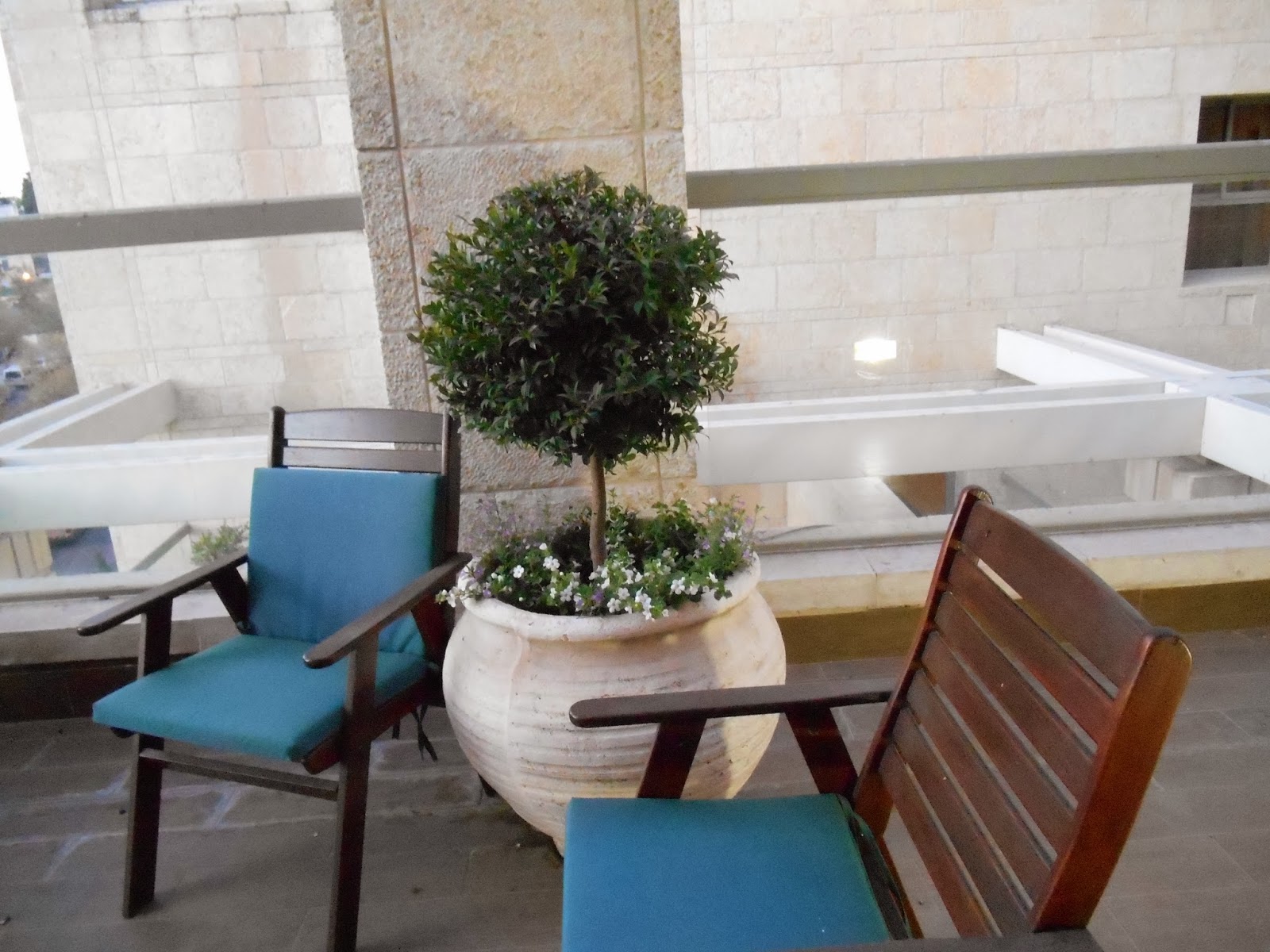
On our patio, we can look out over the city of Jerusalem.

View of Jerusalem from our patio.
At last, we have arrived!

Sunday, October 20, 2013

"P" Help #7: Security at Home

When we're away enjoying our adventures, we need to have peace of mind that our home is protected.  If you leave family at home, you're all set.  If you hire someone to 'house-sit,' you're all set.  If no one is there, what do you do?

My late, beloved parents, Adeline and Reuben, had a fancy security system in their home in Sacramento, California, U.S.A.  They lived there from 1970 to 1990 and frequently drove all over the country visiting me and my brothers.  One brother lived in Ireland, and mom and dad especially loved to visit him and his family which included a wonderful group of his wife's relatives.  They also loved to go on cruises with friends to Europe, the Mediterranean, Hawaii, and Alaska.

The first and only time their security system alarmed, they actually were in town having dinner.  Police alerted them that someone had broken into their house.  Later the neighbors told them, "There was this screeching loud siren, then several minutes later the police cruisers ran in, and nearly the same time, the police helicopter appeared over your house!"  Their neighbors also reported, "The teenagers across the street were sitting on their roof watching the show.  We wonder if they broke into your house to see what would happen!"  Nothing at all was disarrayed or taken from their home.

Nowadays the security systems are much improved, with fire/smoke detection also included, for a price.  You may want to invest in outdoor motion-sensitive lights around your doors.  I'm told that you don't even have to get the light fixtures, you can buy motion-sensitive light bulbs to put in your present fixtures, but I haven't personally looked for them.

Of course, you want to double-check that all your windows and doors are locked, yard gates closed, and that your garage door is down before you leave.  Stop delivery of all mail and newspapers when you'll be gone.  You want your home to look like you're still there.  Timers on lights are suggested, to turn off and on those lights during your usual pattern of being at home.  Arrange for lawn care, if needed.  Don't forget to water your houseplants before you leave, or ask a friend to care for them (plant sitter?).  Make sure your fire detector batteries don't need replacing.

When I was eight years old, my family moved to Louisville, Kentucky, U.S.A.  It was a big old house in a neighborhood without street lights.  One Sunday, when my Army dad was out of town, mom took us kids to the 'country' to visit our aunt, uncle, and cousins.  We came back later than we had planned.  The double wooden garage doors were open.  That was the first thing we noticed.  Mom worriedly said, "I don't remember leaving those open."

Our house was pitch black dark.  Mom unlocked the back door and we went in.  Mom turned on the kitchen light.  She immediately ordered us, "Something's wrong.  We're leaving and getting Grandpa to come over and look around."  Later she reflected, "The door to the (unfinished) attic was open.  We rarely went up there.  I knew someone had been here and thought they still might be inside somewhere."

We came back with Grandpa, brave old Grandpa and his baseball bat!  He looked everywhere, in the attic, in the basement, in every room.  Whoever had been there was gone.  Relief!  We went in.  Nothing looked disturbed.  But mother started looking in closets and cabinets. She had arthritis in her fingers and couldn't wear her diamond wedding rings.  They were stolen from a kitchen cabinet.  Several pieces of silver utensils were taken along with my piggy bank heavy with pennies.  Chicken was taken from the freezer!  Upstairs in the attic, thieves didn't take the expensive movie equipment. Police theorized that, "This must have been teenagers because of what was taken."

The next day mom chatted with neighbors.  They explained that, "We saw your house lit up and all the shades down.  We figured you were playing cards or something."  They promised to alert mom if anything similar ever happened, which it didn't.

Don't forget to unplug your TV.  One of my brothers told me about a friend whose TV was OFF & started a fire due to a malfunction and fire of the part that keeps it ready to turn on quickly.  I don't know if this just pertains to the old 'tube' TVs or for all of them.

A huge barking dog, I'm told, is the best crime prevention you can get. One of my daughters had her German shepherd weighed yesterday: 126 pounds, more than she weighed!  Their dining room window in the front of their house is tall and very low to the floor.  The big dog doesn't let anyone pass by the street without vigorous barking and pacing by the window.  No one would dare come in!  If you don't want to protect your house that way, I'm told there are recordings that are motion-sensitive to sound like there's a big dog in your house.

You may want to ask your local police department to keep a closer watch on your house.  I'm fortunate that a close family friend is a local police officer who frequently comes in the house while I'm gone, "Just to make sure everything's OK."  Think I'll leave him a special box of cookies with his name on it the next time I'm gone!"

Do you know of any other security measures?  You probably don't have to be concerned about the chickens in your freezer!!